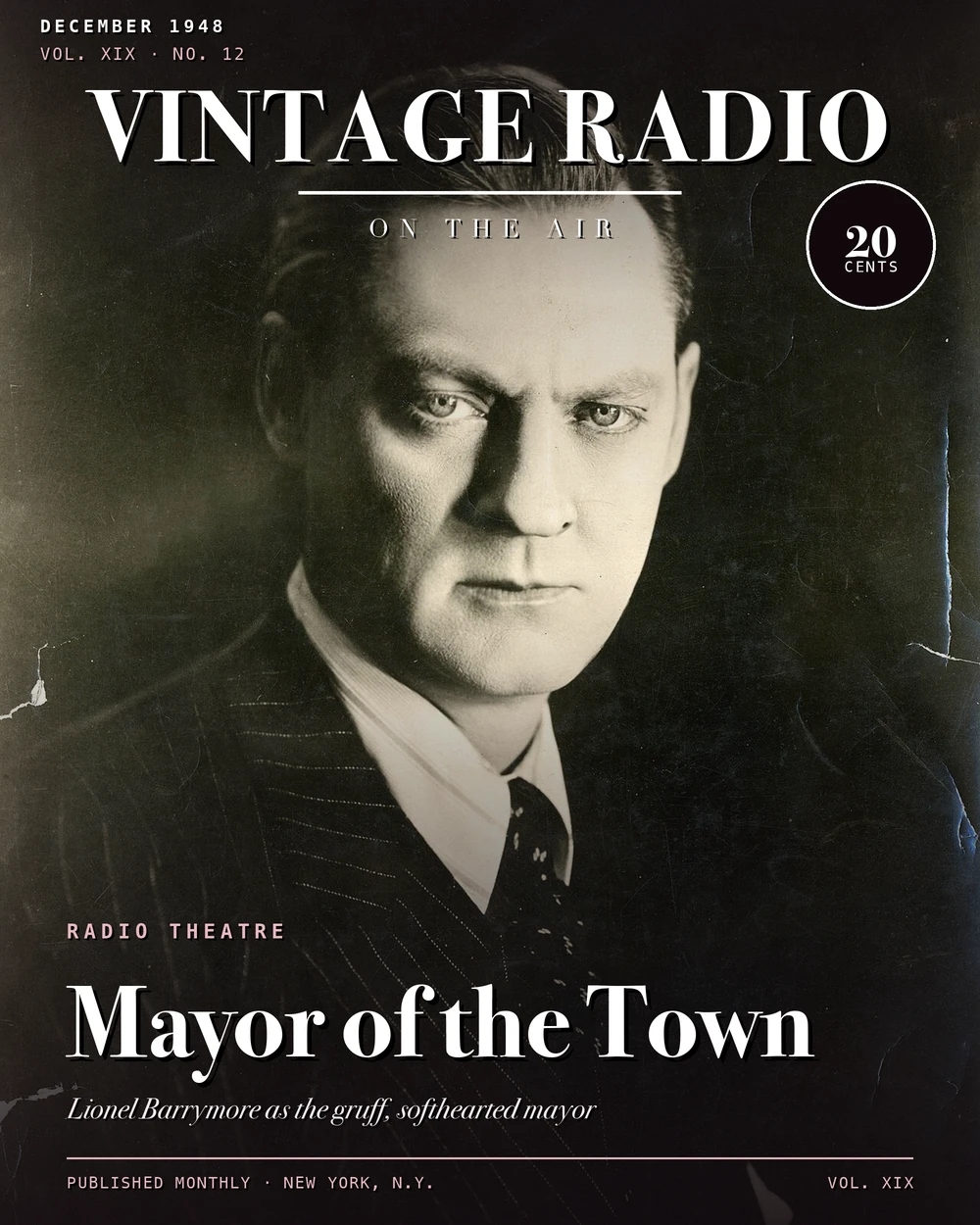
Mayor of the Town
The Show That Fit Lionel Barrymore Like a Glove
Lionel Barrymore spent most of his career playing villains, doctors, and men of authority — but the role that suited him most completely may have been the unnamed mayor of Springdale, a small American town where the biggest crises involved stray dogs, wayward orphans, and the annual question of whether the Christmas Carol performance would come off without a hitch. The show premiered on NBC on September 6, 1942, and ran in one form or another until July 3, 1949, making it one of the more durable small-town comedies in wartime and postwar radio.
It arrived almost by accident. The NBC slot had been held by The Remarkable Miss Tuttle, a summer series starring Edna May Oliver, who became ill after only a few episodes — her role was taken over by Mary Boland before the slot opened up entirely. Mayor of the Town stepped in to fill the gap that September. The NBC run was brief, just four weeks from September 6 to September 27, but CBS picked the show up the following week, and it stayed there until May 1947.
What made Barrymore right for the part was that the mayor wasn't a comic character in any broad sense. He was a man of strong opinions and a fierce bark who turned soft the moment a child or an animal needed something. The character cared nothing about political advantage — he was a small-town official who governed on instinct and stubbornness. Barrymore, who had been performing from a wheelchair since at least 1938 due to a broken hip aggravated by arthritis, brought an authority and warmth to the role that required no physical presence at all. Radio suited him in his later years, and the mayor suited him as a character. He is also said to have written the program's theme song.
Springdale, Street by Street
One of the more unusual things about Mayor of the Town was the care that went into building the fictional town of Springdale. Barrymore himself described the town in Radio Life magazine, and the geography was specific enough to feel lived-in rather than generic. Main Street ran broad through the center of town, flanked by First and Second streets, with cross-streets named after trees: Cherry, Walnut, Locust, and Elm. At the foot of Main Street sat Hill and Market streets, and at the corner of Market and Main you'd find the Idle Hour Theater, Fred Jackson's service station, and two competing town newspapers — the Globe and the Clarion.
The rest of Main Street filled in like a real small town: Grayson's Drug Store, the Bon-Ton Department Store, Veeder's Tobacco Shop, and the Bijou Theater. The Grover House hotel stood at Main and Third, with the Greyhound Bus Depot next door and a tea room called the Pantry beside that — where the mayor's secretary Toni McCafferty took her lunches. The train station sat at the foot of Hill Street, and across the tracks from it was a shabbier section of town, marked by the Avon Hotel, a few poolrooms, and what Barrymore described as a "parcel of juke joints."
These weren't just set dressing. The town church stood at Maple and Spring, presided over by Reverend Dinwiddie, described as a fussy little man who nonetheless gave a good sermon. The church sexton was farmer George Meader, who, in the mayor's words, "swings a mean call to church." Judge Williams was the best checker player in town — next to the mayor, the mayor would add. Miss Grew, nicknamed "Gruesome" by her students, taught at Elmwood School. Springdale occupied the same imaginative space as Dr. Christian's River's End or Throckmorton Gildersleeve's Summerfield — a radio town with enough texture to feel like it had existed before the microphone turned on.
The People in the Mayor's House
The three characters at the center of the show were the mayor, his housekeeper Marilly, and his ward Butch. Agnes Moorehead played Marilly with the kind of sharpness she brought to everything — she entered storylines by complaining about the mayor's tardiness or by passing along gossip from her friendly enemy Abby Peters. Moorehead had already built a remarkable radio résumé before the show: she had joined Orson Welles's Mercury Players by 1937, appeared in The Mercury Theatre on the Air, was part of the famous War of the Worlds broadcast, and held a regular role as Margo Lane in The Shadow. She brought a professional precision to Marilly that kept the character from being merely a comic foil.
Conrad Binyon played Butch, whose real name was Roscoe Turner. Butch came to live with the mayor after the first season, when his mother died and his father went to fight with the Seabees. The backstory gave the relationship between the mayor and Butch a genuine weight — many of the show's episodes were essentially coming-of-age stories built around the two of them. They fished together and swam at the hole near Rock Creek. On warm nights Butch would play under the streetlamps chasing fireflies with his friends Bitsy Morgan, Peewee Taylor, and Sharlee Bronson. The mayor would often come home from City Hall to find Butch hanging on the gate waiting for him.
The supporting cast drew from Hollywood talent, including Will Wright, Sharon Douglas, Irvin Lee, and Marjorie Davies. Gloria McMillan played Sharlee Bronson, Butch's best girl. Priscilla Lyon played Holly-Ann, the mayor's granddaughter. Murray Bolen produced the show in its early period before Knowles Entrikin succeeded him. Jack Van Nostrand and Arthur Trask shared directing duties. Writers over the run included Jean Holloway, Leonard St. Clair, Howard Blake, Ema Lazarus, Howard Breslin, and Charles Tazewell, with Breslin and Tazewell alternating weeks around 1945.
Sponsors, Networks, and the Long Road Through Radio
The show moved around more than its comfortable small-town feel might suggest. Rinso — and for a period Swan Soap alongside Rinso — sponsored the NBC and early CBS runs. The CBS years alone covered multiple time slots: Wednesday nights, then Saturday evenings, with the hour shifting several times between 1942 and 1947. Noxzema came on as sponsor for the later CBS period and stayed through the ABC run, which lasted from October 8, 1947, to June 30, 1948, airing on Wednesdays at 8. Mutual Benefit Insurance picked up the final run on Mutual, which aired Sundays at 7:30 from January 2 to July 3, 1949.
The musical direction changed across the years as well. Gordon Jenkins led the orchestra around 1943, Bernard Katz took over in 1945, and Frank Worth served as orchestra leader at another point during the run. Wilbur Hatch — a CBS music director who had composed the theme for The Whistler and would later conduct the Desi Arnaz Orchestra on I Love Lucy — also worked as musical director on the show. Organist Con Maffie provided organ work, Frank Martin served as announcer, and the sound effects were handled by David Light and Mary Ann Gideon.
One recurring tradition anchored the show's identity each year. Barrymore had been performing Ebenezer Scrooge in annual radio broadcasts of A Christmas Carol since 1934, and that tradition fed directly into Mayor of the Town — each Christmas, Springdale became, in effect, a special theater for Dickens, with the mayor staging his annual Scrooge performance. The December 24, 1942, episode was among the earliest to survive, and it documents how naturally that tradition worked within the show's format.
After the Show Ended
Lionel Barrymore — born Lionel Herbert Blyth on April 28, 1878, in Philadelphia — had won the Academy Award for Best Actor for A Free Soul in 1931 and would become most widely recognized by later generations as the villainous Mr. Potter in Frank Capra's It's a Wonderful Life in 1946. He received two stars on the Hollywood Walk of Fame in 1960, one for motion pictures and one for radio, making him the only Barrymore honored in both categories. He died on November 15, 1954, in Van Nuys, California.
A television version of Mayor of the Town was in planning as early as 1951, with Barrymore expected to reprise his role. His deteriorating health prevented it. The series finally premiered in November 1954, with Thomas Mitchell playing Mayor Thomas Russell, Kathleen Freeman as Marilly, and David Saber as Butch. The 39-episode syndicated series was produced by Rawlins-Grant Productions and Gross-Krasne Films, directed by John Rawlins, and featured notable guest appearances by Natalie Wood as the mayor's niece and DeForest Kelley in three episodes. Contemporary press described the premiere as bringing "to life and TV the role of Mayor of the Town that was created for radio by the late Lionel Barrymore" — Barrymore having died the same month the television version reached audiences.
Agnes Moorehead went on to earn four Academy Award nominations for Best Supporting Actress — for The Magnificent Ambersons (1942), Mrs. Parkington (1944), Johnny Belinda (1948), and Hush...Hush, Sweet Charlotte (1964) — and gained her widest audience as Endora in the ABC sitcom Bewitched from 1964 to 1972, receiving six Emmy nominations for that role. She was posthumously inducted into the Radio Hall of Fame in 2012. Writer Jean Holloway, who had scripted episodes of the radio original, wrote the television adaptation — a rare thread of continuity between the two versions of the same show.